Prints the current language. Choose A4 and Save as PDF in your browser. Review status and references remain included; this is a teaching inspiration sheet, not a certificate.
LEARNING INSPIRATION · CTL / EDC
Wamena Stone Cooking: Where Does Heat Go?
SMP · Wamena · Jayawijaya
Classroom planning proposal
Adapt with a teacher; this is not an approved grade/phase mapping.
Proposed grade/phase
Junior secondary Grades 7–9; a science teacher selects the appropriate heat-transfer learning stage.
Suggested duration
40–60 minutes for sequencing, heat-transfer diagrams and peer response.
Materials
Attributed, permitted stone-cooking documentation, sequence cards, diagram sheets and vocabulary support. No hot stones, flames or experimental steam.
Learning evidence
A directional heat-transfer diagram, one pathway explanation and a distinction between observation and inference.
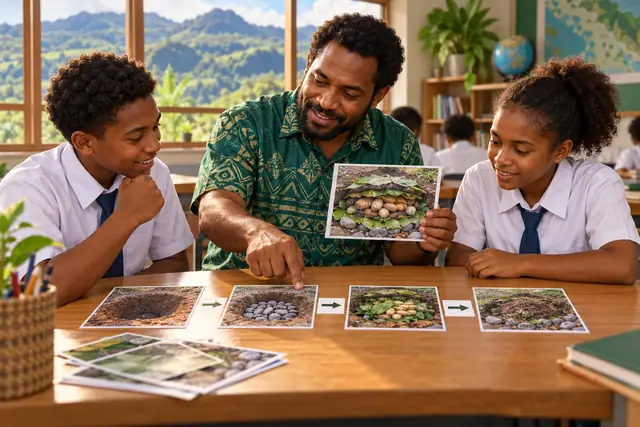
AI illustration for learning. Not a documentary photograph or a species-identification image. Confirm species details and cultural context with appropriate references and knowledge holders.
Goal — Junior secondary: explain heat transfer and sequence a process.
Experience — Examine authorised documentation of stone cooking in Wamena/Jayawijaya. Sequence picture cards and ask, “How does food receive heat without touching a flame?” Use images rather than hot stones.
Deconstruct — Trace heat from stones to materials touching them, and discuss steam and coverings. Guide learners to distinguish conduction and convection. Separate visible evidence from ideas that still require testing.
Create — Groups draw an arrow diagram labelled “heat”, “stone” and “food”, then explain one heat-transfer pathway. Another group asks questions and checks arrow directions.
Teacher reflection — Invite a community resource person to explain local terminology and practices; avoid treating all highland traditions as identical. The science model explains heat rather than replacing cultural meanings. Offer visual prompts to learners who need explanation support.
Context references
These references support the context; EDC activities are PTLH teaching proposals.