Goal — Junior secondary: read cultural sources, ask respectfully and explain diversity.
Experience — Explore seven customary-region names: Domberai, Bomberai, Saireri, Tabi/Mamta, Mee Pago, La Pago and Anim Ha. Invite familiar names without requiring learners to disclose personal customary identities.
Deconstruct — Distinguish customary regions, provinces, regencies and communities. Each customary region contains diverse languages and knowledge; its boundaries do not automatically match administrative ones. Compare readings with a consenting community speaker. Which information is sourced and which is an assumption?
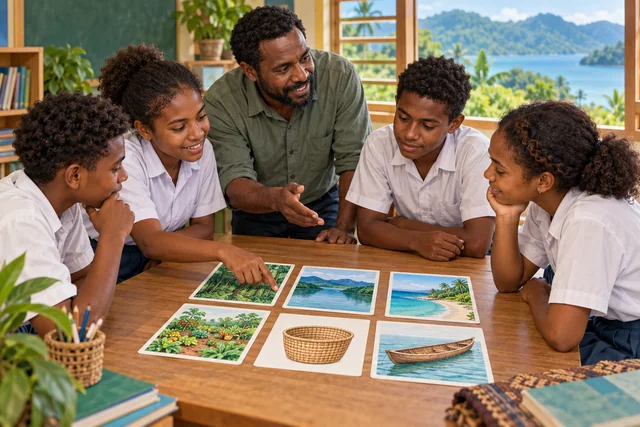
Create — Groups choose a familiar context: art, homes, food, forests or waters. Make a story card with observations, sources, one question and respect for knowledge holders. Peers check clarity and generalisations before revision.
Adaptation — Primary learners use pictures and short stories; senior secondary learners compare sources; vocational learners create bilingual visitor interpretations. Assess accuracy, reasoning and respectful engagement. Do not publish restricted knowledge without permission; this activity does not determine customary boundaries or rights.